

The AI review layer for work that matters.
Work with GPT, Claude, Gemini or Grok. Add specialist reviewers, challenge any answer with a model from a rival lab, and audit important work before you act on it.
“The acquisition structure is sound. Year‑three revenue of $4.2m supports the earn‑out, and the warranty cap is market standard.”
The year‑three revenue figure conflicts with the source material on page 18, which states $3.1m. The earn‑out schedule depends on it.
Four rival minds.
One verdict.
Your Multi-Agent Team is OpenAI, Anthropic, Google and xAI — four rival labs on the same piece of work. They review it, debate it, cross-check each other for the blind spot one model would miss, and return a verified verdict you can act on.
See how a run works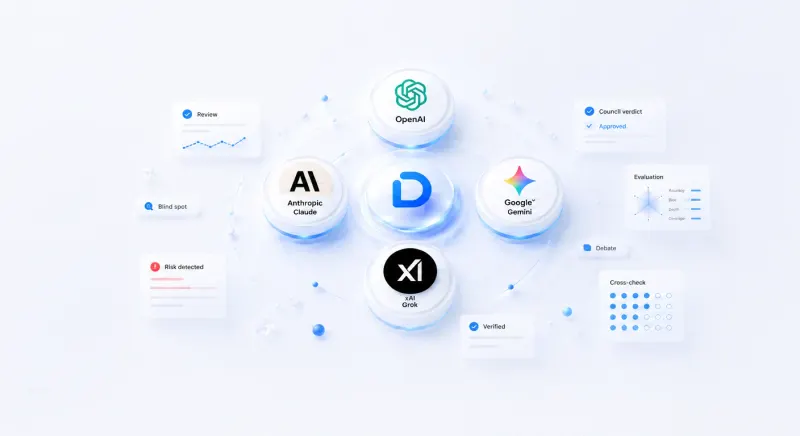
One model can be confidently wrong
Its training goes stale, its memory misremembers, its bias flatters — and it tells you with total confidence, right when your case, your raise or your name is on the line. The team cross-checks it against rival models and the source of truth, and catches what one AI would have let you walk into. Illustrative examples — the reasoning is real and checkable.
Drop it in. The right team takes it.
One tool per job — the minds already seated, your file in, the finished version back. Included with Plus.
Ask one model to check its own answer and you get that answer again, rephrased.
You don’t know what it missed, which assumption it skipped, or where its maker’s training left a blind spot. Decidi runs competing models from different labs against each other — so where one vendor is weak or biased, the others catch it. Independent minds, no single point of failure — before you commit.
“ChatGPT can make mistakes. Check important info.”
“Gemini can make mistakes, so double-check it”
“Claude can make mistakes. Please double-check responses.”
“Grok can make mistakes.”
Every lab prints the same warning under its own answers — then leaves the checking to you. Decidi is the check. See what they all admit →
We hold the work to the failure modes we catalogue in the AI Risk Library — each layer clears the ones in its remit, and anything that slips through is flagged to you, never shipped silently. An illustrative model of the process, not a measured catch rate.
Four steps to work you can trust
Free, and no account. Ask anything, paste your work, attach the contract or the deck.
When the stakes are real, Decidi names the specialists worth bringing in — from 92 expert minds — and shows what it draws on your plan before anything runs.
GPT, Claude, Gemini and Grok take the question from different sides. A model cannot wave through its own reasoning when three rivals are reading it.
A separate Final QA audit reviews the answer before you see it, then names exactly what you still need to verify.
Not a chat log — a deliverable that has already survived an audit
Every run ends in one verdict, reviewed before you see it by a Final QA auditor that took no part in the debate — with what still needs checking named. Build it out then produces the thing itself — a designed document, a real Word, Excel or PDF file, an image or a short video.
Not yet — you’re about two weeks out. The product itself is strong, but the first-run experience won’t convert paid users. Launching now would spend scarce attention on a leaky funnel — clear the fixes below first (and open a private beta in the meantime).
- New users hit an empty state, not the value — high churn on day one.
- Pricing isn’t legible; “credits” read as friction at checkout.
- No trust/security page yet — enterprise and cautious buyers bounce.
- P0 — Redesign the empty/first-run state to show value immediately.
- P1 — Translate pricing into “what one decision costs”.
- P1 — Add a Security & Privacy page before paid launch.
- P2 — Instrument onboarding funnel; run 10 user tests.
“Two weeks of runway isn’t free. If the beta validates retention, launch on schedule and fix onboarding in-flight rather than slipping the date.”
One model vs. the team
- You ask one AI.
- It gives one confident answer.
- You don’t know what it missed.
- You paste into another model and compare by hand.
- You still have to decide alone.
- Multiple models respond — in their own voices.
- Expert minds challenge the assumptions.
- Risks and blind spots are surfaced.
- Trade-offs are ranked, dissent is shown.
- A moderator hands you one decision memo.
The work you cannot afford to get wrong
Bring the filing, the pitch, the contract or the launch plan into the chat. When it matters, the specialists in your field take it, argue it out, and hand back the version you can put your name to. Pick your profession.
Find the hole in your argument before opposing counsel does.
Run the pre-mortem before reality runs it for you.
Kill the deal on paper before you wire the money.
Bulletproof the recommendation before the steering committee sees it.
Find the claim that gets you screenshotted before it ships.
Pressure-test the bet before engineering builds the wrong thing.
Survive the design crit before it’s in front of real users.
Get the staff-engineer code review before you open the PR.
Find the weak line before the client circles it in red.
Start from a proven brief
52 battle-tested debate briefs — each tells the team what to evaluate and what to deliver.
An exhaustive UX teardown of your app before you launch it.
A visual and UI teardown of your app — hierarchy, type, polish, dark mode.
Decide what to build next quarter and what to deliberately not build.
Design pricing, tiers and the value metric that scales with what you deliver.
Pressure-test a startup idea before you commit a year of your life.
Get your deck shredded the way a real partner meeting would.
Pressure-test a system design before you commit to it.
Align your money with your goals, time horizon and risk appetite.
Surface the clauses in an agreement that could hurt you later.
Real models. Shown openly.
Three levels, each a genuine mix of frontier models — never one model wearing different hats. Deep comes with Pro.
Fast, low-cost models — a lively first pass.
Proven pro models — the everyday default.
The newest, most capable models — for when being wrong is expensive.
Each mind on the team is assigned a different live model, round-robin across providers.
Every contribution is labelled with the model that produced it.
Cost is computed from real token usage with a transparent markup — shown before and during.
If a model is briefly unavailable, the team notes it and continues — never fakes a reply.
Free to think out loud. Paid when it matters.
A plan counted in full runs — one question, the whole team, one signed-off verdict — not credits. 16 a month on Plus, 44 on Pro. Chat is free with no account, and a free account adds one specialist consultation on the house.
- Chat free, every day — no account, no card
- A free account keeps your conversations
- One specialist consultation and your first full run, on the house
- Unlimited chat and every specialist mind
- Panels — two or three minds cross-examining
- Your library, on hand in every conversation
- Everything in Plus
- Working teams that divide the job and produce the deliverable
- Deep — the flagship models end to end, up to 9 runs of it
Top up, only if you outrun your plan
See what each top-up adds →Every run includes the proprietary Final QA audit. Top-ups add to the same meter your plan already runs on — they never expire, members save up to 20%, and most months you will not need one. Full pricing →
Your messages and files are used only to do your work — never to train public models. Encrypted in transit and at rest, deletable on request.
Multi-agent, supervised
Would your answer survive three rivals reading it?
One model will agree with you. Rivals argue. Start in chat for nothing, and put the calls that matter to a team that has to reach a verdict — and sign it off.
Free to start · no account, no card
Common questions
What is a Multi-Agent Team?
A Multi-Agent Team is several independent frontier models — GPT, Claude, Gemini and Grok — each carrying a specialist persona, working the same question and reading each other’s reasoning. They disagree in the open, then a separate Final QA audit reviews the result. You get one cross-checked verdict instead of one model’s opinion. If you arrived looking for the Decidi council, this is it, under its plainer name.
What is Decidi?
Decidi is an AI chat that escalates. Everyday questions get an instant free answer. When something real is at stake — a contract, a launch, an investment, a plan you are about to act on — Decidi puts a team of named specialist minds on it, has rival models argue it out, and returns one audited verdict with the open questions named.
How is Decidi different from ChatGPT or Claude?
ChatGPT and Claude are single models answering alone, and a model asked to check its own work tends to restate it rather than challenge it — a second opinion from the same mind is not a second opinion. Decidi starts as ordinary chat, then puts the important calls to rival models from different labs, so disagreement surfaces instead of staying hidden, and a separate audit signs the answer off.
How does Decidi stop AI hallucination and drift?
Three ways, and none of them is asking a model to grade itself. Rival models from different labs review the same work, so one model’s invention has to get past three others. Live web research grounds facts that change. And a proprietary Final QA audit reviews the verdict before you see it, then hands you a short “verify this” list — because the honest answer is that you should still check the load-bearing claims.
Is Decidi free?
Yes — chat is free and needs no account, every day, under a generous fair-use allowance you'll only ever hear about if you reach it. A free account keeps your conversations, and comes with one consultation with a named specialist and your first full Multi-Agent run — both on the house. Beyond that it is a monthly plan, counted in full runs rather than credits. Plus ($19 a month) gives you unlimited chat, unlimited specialist minds, panels and 16 full runs a month; Pro ($49) adds working teams, Deep depth and 44 runs a month. Cancel at any time.